Inside Uluwatu Temple: The Split Gate, the Cliff Path and Every Viewpoint
The short answer
Uluwatu is an open-air site, so there is no interior to tour. The walk is: the split gate, two outer courtyards, then a cliff path that runs north and south along the rim. The northern arm is the one with the view back at the temple; the southern arm leads to the amphitheatre. An unhurried circuit takes about an hour.
The shape of the site, before you set off
Pura Luhur Uluwatu is small. It is a handful of walled courtyards on a headland, and almost all of what people photograph is the setting rather than the buildings. That matters for planning, because it means the walk is the attraction and the walk is not long.
From the ticket window a paved path climbs gently to the gate. Past the gate the ground opens out, and from there you choose a direction. Most of the crowd turns left and south, toward the amphitheatre, which is exactly why the other direction is worth taking first.
From the car park to the gate
The car park sits below the temple, and the first thing that happens is the ticket window. This is where the queue forms in the late afternoon, and it is also where the macaque troop is densest — the path is narrow, people are getting bags out, and the animals have worked out what that means.
Sort yourself out before you join the queue rather than after. Sunglasses off your head, phone in a zipped pocket, nothing hanging from a strap. The sarong and sash come with the ticket and are handed over here, so there is nothing to buy from the stalls on the way up.
Toilets, drinks and simple warungs are all clustered around this point. There is nothing out on the cliff path, and no shade on most of it, so fill a bottle now. The 2026 rates and what they include are set out on visitor information, and the drive down is on the map.
The candi bentar — the gate you walk through
The entrance is a candi bentar, the split gate that is the signature form of Balinese architecture: one carved tower cut vertically in two and drawn apart, so passing through it is walking between the halves of a single thing. Look at the two faces as you go through — the carving is continuous across the gap, which is the point of the form.
Two stone statues flank the approach. The one detail worth noticing is how worn the coral limestone is: the material is porous, the air is salt, and everything here is repaired rather than preserved.
The outer courtyards, and what you can and cannot enter
Beyond the gate are the outer courtyards, which is where visitors spend their time. The walled inner sanctuary, the jeroan, is for worshippers at prayer, and it is closed to everyone else. That is standard practice across Bali.
You lose very little. The inner shrines are visible over the wall from the path, and the elements that make the site remarkable — the gate, the setting, the drop — are all outside. The full background is on Pura Luhur Uluwatu.
The northern cliff path — the view everyone has seen
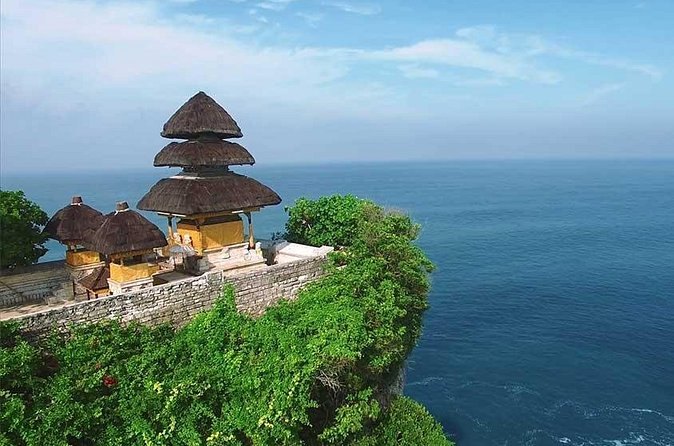
Turn right. The northern arm runs along the rim for several hundred metres, with a low wall on the seaward side and scrub on the other. About two-thirds of the way along it bends, and from that bend you get the view: the temple on its point, the cliff dropping away beneath it, open ocean behind.
Every photograph of Uluwatu you have ever seen was taken from somewhere along this stretch. It is also the quiet arm, because the crowd goes the other way toward the seats.
The southern path and the amphitheatre
South from the gate the path drops gently toward the open-air theatre cut into the cliff. The seating is tiered stone, unreserved, and it faces west so that the stage has nothing behind it but sea and sky.
This is where the six o'clock performance happens, and where the crowd is. If the dance is your plan, this is the direction to be walking by half past four.
Where to stand for the sunset
Two answers, and they are different. If you have a dance ticket, the best seats are the upper rows on the northern side of the amphitheatre — high enough to see over the crowd, angled so the sun sets behind the stage rather than into your eyes. Travellers describe guides steering them to exactly that corner.
If you do not have a ticket, the northern cliff path is better than anywhere near the theatre. You get the temple silhouetted against the light, and you get it without several hundred people in the frame.
The macaques, by location
They are not spread evenly. The heaviest concentration is between the ticket window and the gate, where the path is narrow and people are still sorting out their bags. The northern path is usually quieter. The amphitheatre approach has its own resident group.
- Zip everything shut before the ticket window, not after.
- Nothing on your head. Sunglasses go in the bag, not on your collar.
- If something is taken, do not chase it. Staff handle these exchanges daily.
A route that works
| Time | Where | Why then |
|---|---|---|
| 16:00 | Ticket window, then the gate | Queue is short, light is still high |
| 16:15 | Northern cliff path and back | The classic view, before the crowd |
| 16:45 | Outer courtyards | Carving is easier to see in low sun |
| 17:00 | Dance box office, then a seat | Ahead of the rush; upper northern rows |
| 18:00 | Kecak and Fire Dance | The one performance the sunset lands in |
An hour and a half, and it covers everything. Timings for other months are on the weather page, and the drive down is on the map. If you would rather not watch the clock at all, an Uluwatu Temple tour that holds the seat does it for you.
What is not here
No museum, no interior, no exhibits and no audio guide. Uluwatu is a working temple on a cliff, and the experience is walking it. Anyone expecting a building to go inside will be disappointed within twenty minutes; anyone expecting a headland and a performance will not. What else is within reach is set out in things to do.
Want the walk narrated? The trips that meet at the entrance put a guide beside you for it — see them on Uluwatu Tours.
Trips with a guide for the walk
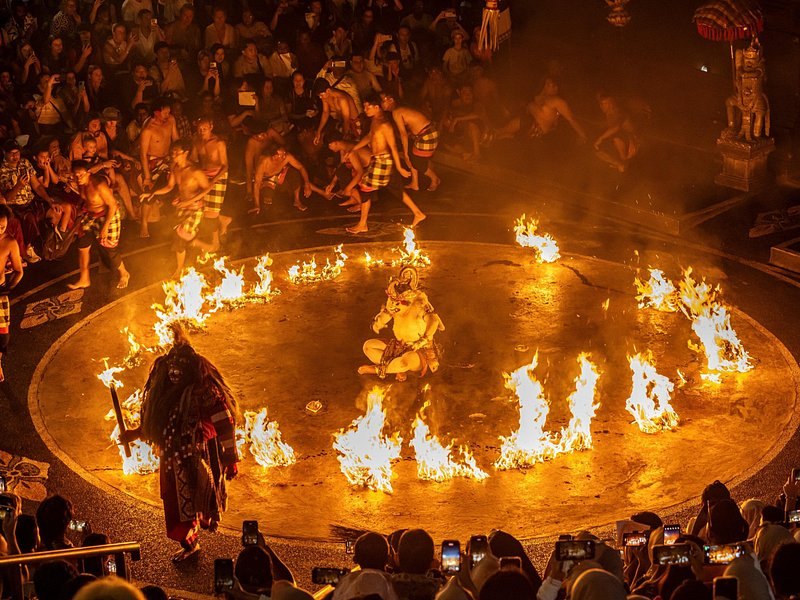
Uluwatu Temple Entry and Kecak Fire Dance Ticket
Both tickets bought for you and a guide waiting at the entrance. Two hours, no car.
From $28 per person
Check Availability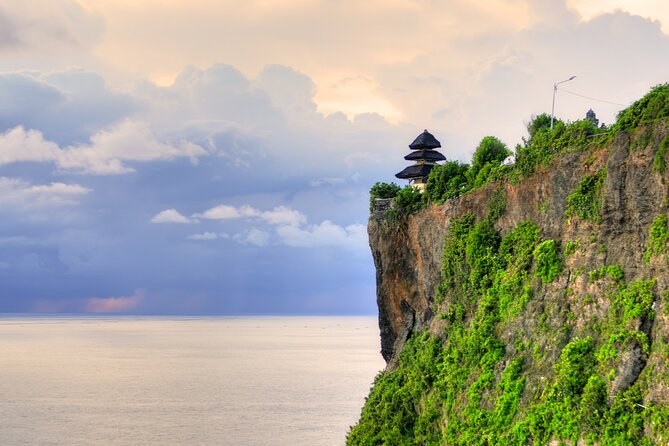
Private Tour: Uluwatu Temple & Southern Bali Highlights
Two hours on the clifftop, the longest of any run, with Pandawa Beach first.
From $45 per person
Check Availability